You are Human, We are Human: Supporting Undergraduate Researchers in Seeing Rest, Recovery, and Flexibility as Part of Work

We introduce you to a written handout and cultural practice that supports our undergraduate researchers in understanding what counts as work. In particular, we emphasize the weirdness of research, how to build in rest and recovery time, and how to look out for each other as humans.
Authors: Angie Little, Jazmin Russell, and Joel Corbo
Introduction
Supporting undergraduate researchers should be part of what all university research groups do, but our group in particular has a commitment to doing right by students. Many of our projects explicitly center marginalized student voices in institutional change. Part of centering student voice means regularly hiring undergraduate student researchers to work on our teams. Our commitment to students has led us to reflect and iterate on how to support our student researchers better each year. Although no group is perfect, we got our group culture working for us in a particularly good way in the last few years. We had undergraduate researchers who worked part-time for us and part-time for other jobs, and by the end of a summer of working with us, they asked if they could continue their work over the semester because we actually treated them as humans. I’ve pulled in one of these students to share her story. I hope that by sharing this story we can show what is possible, as well as some of the tools and culture we built to get there.
My name is Dr. Angie Little. I’m a Research Lab Steward for a Physics Education Research group at Michigan State University. I work in creative project planning, structure-building, and mentorship for our research group. I support our group members to be human, share the load, build community, and grow ourselves. The research group is led by two physics faculty members, Dr. Vashti Sawtelle and Dr. Rachel Henderson. Our group is situated within the Physics Education Research Lab in the Department of Physics and Astronomy.
Fundamentally, we want all of the folks who work in our research group to feel cared for as humans. We want people to have a living wage and to have rest, recovery, and community building as part of their paid work time. The undergraduate researchers on our teams are often new to research jobs. In addition, our students are often coming from jobs in food service or other large corporate stores where they are only given the bare minimum of state and federal requirements for breaks. We have found that explicitly putting in writing “what counts as work” is an important aspect of supporting the undergraduate students we hire.
Over the years, there have been many influences on our thinking about the importance of rest and recovery as part of building a sustainable working community. This deserves its own extensive post, but for now, we quote two folks from Indigenous and Black communities, respectively, who have dreamed and written explicitly about rest. Dr. Gregory Cajete wrote a book called Indigenous Community. In it, he calls out the challenge of American individualism. He characterizes sustainable communities as ones in which people “take time to recreate as a community” and in which individuals are supported in “actively pursuing their personal development, which involves rest, relaxation, transformation, learning, and self-change.” Tricia Hersey’s Nap Ministry work, including her recent book Rest is Resistance: A Manifesto, describes how "rest is a form of resistance because it disrupts and pushes back against capitalism and white supremacy." Therefore building rest and recovery into what counts as work helps everyone to move toward sustainability, but it is particularly important to consider overwork and exhaustion as issues of justice.
Putting in Writing What Counts as Work
Research jobs are weird if you have never experienced them. No faculty member that I know of sits at their desk for 8 hours straight focused only on research. However, prior job experience might make students think that “being on task for 8 hours straight” is a standard part of work. We’ve created a handout to help students understand the weirdness of research. In particular, we hope that this handout helps to convey that our group cares about people as humans and to make our expectations transparent.
Our context is research in university science education. This means that a lot of our research happens on a laptop with students analyzing qualitative or quantitative data. In addition, our undergraduate research students are often working part-time for us and taking classes or working part-time for other jobs. This means that they are typically tracking their hours in some way, such as submitting a timesheet. We want to make sure that they are not overly restrictive in counting certain things—like research group lunches—as work.
In our student handout, we share a written set of principles around what counts as work. Then, we give a set of general “rule of thumb” examples to give students guidance. Finally, we make suggestions for the easiest way to set up a work day, while giving flexibility as needed. I’ll walk you through some excerpts from our handout here.
We start with the section on helping students identify what counts as work. This includes:
Some general principles about what counts as work:
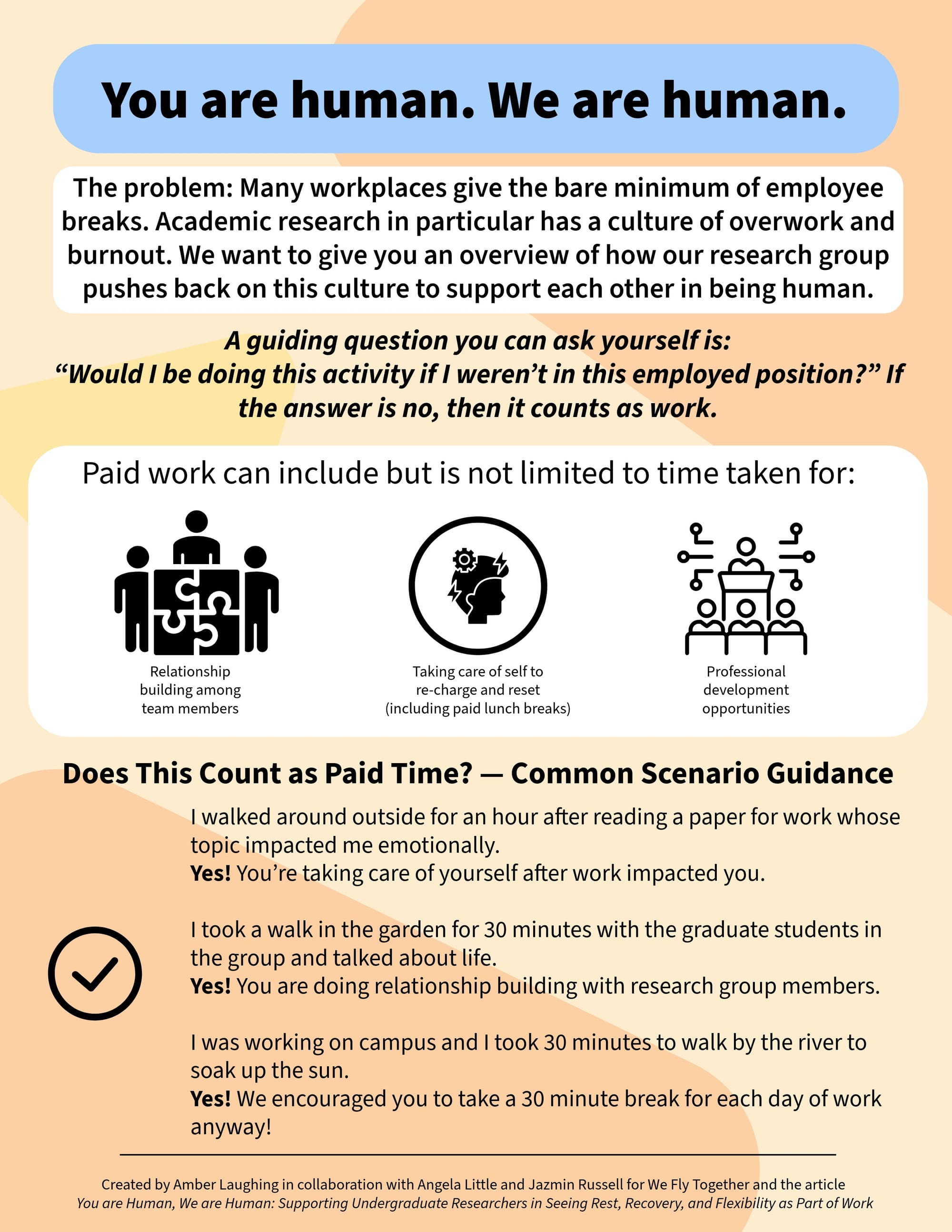
- We consider taking care of ourselves to be part of paid work. For instance, if you need quiet time in the middle of the day to recharge, please take it. If you need to walk around the building to move your body, please do that. Work impacts us—whether it’s sitting for extended periods, focusing our brains for extended periods, interacting with other humans, or reading about issues that are emotionally challenging. Therefore, part of work is building in the recovery time that we need.
- We consider building relationships with other research group members to be part of paid work.
- We consider many professional development opportunities to be part of paid work. There are some listservs that we can make sure that you are signed up for to learn about what is available.
- At a bare minimum, we encourage you to take a paid 30 minute lunch break and two paid 15 minute breaks for each day that you work. However, more (paid) time away from focused research is usually needed to take care of yourself, build relationships, and participate in professional development. Research is a weird activity that can be tiring. Sometimes the most productive thing to do is to take a 15 minute walk in the gardens and soak up the sun or to walk to our building’s coffee shop with a group of folks. Your research advisors can’t do research for 8 hours straight and we don’t expect you to, either!
A guiding question you can ask yourself is: “Would I be doing this activity if I weren’t in this employed position?” If the answer is no, then it counts as work.
After this section we then provide a set of typical examples our students might wonder about:
Rule of Thumb Examples: Guidance for Various Scenarios
I took a walk in the campus garden for an hour with the graduate students in the group and talked about life. Do I count this as paid time? Yes! You are doing relationship building with research group members.
My back was really hurting after sitting for my morning meetings and I did a 15 minute YouTube stretching video. Do I count this as paid time? Yes! You’re taking care of yourself after work impacted you. Also, can we help you stand during meetings, take more breaks between meetings, or do something different to prevent this from happening in the future?
I read a paper for work. The topic of the paper impacted me emotionally because it related to some of my past trauma. I walked around outside for an hour. Do I count this as paid time? Yes! You’re taking care of yourself after work impacted you.
I attended a campus event about how to apply to graduate school for two hours this afternoon. Do I count this as paid time? Yes! Part of being a summer research student is attending professional development opportunities.
I was working on campus and I took 30 minutes to walk by the river. Do I count this as paid time? Yes! We encouraged you to take a 30 minute break for each day of work anyway! And, while our team is still figuring out how to put this into words, we think work should involve some time to rest and to dream.
I left campus to go to a dentist appointment in the middle of the day and was away for two hours. Do I count this as work? No. This would be considered a personal matter. While doing something like this is OK within the flexibility we’ve outlined for your position, you wouldn’t charge for this time.
After this section, we have information about how we suggest setting up a work week, while also supporting flexibility as needed. For instance, one area we discuss is:
Why we suggest working from campus, but we encourage flexibility when needed:
- We think that clocking in and clocking out from campus is the easiest way to support you in your holistic health because it is easier to track your time when you are in the office. Tracking your time while working at home is a skill to develop. You are likely to under-report your time and take less paid breaks when working from home. However, there are reasons why you might need to work remotely. We will work with you to develop the skill of remote time tracking when needed.
- Time on campus is also helpful for building relationships and attending professional development opportunities.
You can find additional detail linked in the full handout.
Intentional Messaging from Managers and Mentors
Providing an explicit written handout around expectations is one part of creating a research group culture where we care about each other as humans. However, group culture is often solidified through small moments in one-on-one meetings.
When I am a manager or mentor, I try to model the importance of rest, recovery, and community building myself. When I set up an agenda for a one-on-one meeting, I always make the first agenda item some kind of check-in. For instance, my agenda might look like this:
Agenda
- General check-in
- Any need for bathroom, water, caffeine, moving your body?
- What is one thing that helps you stay grounded?
- Logistics
- Main thing
I might also set up a two-hour long co-working meeting with a student where we work together in increments of 45 minutes of focus with a 15 minute break. This timing doesn’t work for everyone’s bodies and focus-styles, so I try to check in with students on how it feels. This is a part of building our skills in knowing what is good for our personal needs for work and what is not. At the very least, it messages that I don’t expect straight focus and that breaks are an important part of focusing on writing or research analysis tasks. There are many tools worth checking out and research that suggests that breaks and creative activities are critical to being able to focus.
I am also aware of how talking one-on-one or in a group, particularly on Zoom, impacts people differently. Some people may feel energized by talking. Others might need more time to recharge their nervous systems after being around people and noise. After a long Zoom call, I will often tell folks that I work with that “I’m paying you to go walk around outside right now.”
Our group leadership also has explicit conversations around being intentional in building community. We have weekly lunches over the summer, and we encourage students to join outings to the campus dairy store for ice cream. We have a messaging system (Slack) where people regularly post things like, “I’m going for coffee, anyone want to walk?” or “I’m taking a walk around the building, anyone want to join?” It is through these small moments that we build our culture.
Handing Off to Jazmin Russell: Sharing Experiences
Jazmin Russell was an undergraduate research student in our research group at Michigan State University for about a year. She is completing her degree in neuroscience and plans to apply to PhD programs in Clinical Psychology this fall. I asked Jazmin to join me in writing this piece, as I think we got some things right in our messaging and group culture while she worked for us. Her research mentor was Dr. Vashti Sawtelle, one of the faculty leads of our research group. In the following two sections Jazmin shares some of her experiences working in our research group and contextualizes those experiences in her own history of work.
Example: Feeling Feelings around Taking Breaks
In customer service, much of your worth is defined by how much you can accomplish or how much you are willing to sacrifice for the company. When I started my undergraduate studies, I worked as a barista at a local coffee chain to make ends meet outside of scholarships. In that position, it was expected that you would work 7 to 8 hour shifts with no break. If it was slow, you and your fellow coworker could take turns running to the back to scarf down a few bites of a meal before the next customer walked through the door. However, having that down time was not something you were entitled to. I got the message that a model employee would endure no breaks with no complaints. Oftentimes, I would struggle with those shifts. It seemed ridiculous to me that we weren’t even deserving enough of a break to eat. At the same time, I felt guilty for feeling like I needed one when everyone else just seemed to put up with it.
Eventually, when I transitioned into my research group position, the severe work culture shift was startling to me. It was something that I really struggled to adapt to at first. It was hard to transition from a workplace where you were just another cog in the machine to one where you were a person with wants and needs. I remember that in a weekly recap meeting with my research mentor, Vashti, she said to me, “you’ve done so much this past week, which is amazing, but I don’t see anywhere where you say you’d rested.” That conversation really stuck with me. It made me realize that my whole life I had been conditioned into a constant on-the-go mentality where rest was never accounted for. There was always a deadline to meet, a person to meet with, or some work you could have started earlier if you had had the time. After that conversation, my mentor made me always tell her one thing I had done for myself that week to rest.
In another meeting with Vashti, I remember I had expressed that I was feeling frustrated with myself for not being able to get everything I needed to do accomplished in one long sitting. I told her that I would find myself mentally checking-out after long periods of time sitting still and working. During that meeting she told me that working consistently through long periods of time isn’t realistic and that she “would rather you take an hour break to be more productive in the next two hours than struggle through 3 hours and not get anything done.” This made me pause and think about how willing I was to still ignore my body when it was telling me that I needed rest. I was still imposing on myself unrealistic and imaginary expectations in a work space that supported resting. Now, whenever I mentally feel myself slowing down, I am more willing to listen to my body. I often get up and walk away from whatever I am doing for an hour without feeling guilty for doing so.
I think that working in a group that understands that the people doing the work are human ultimately helped me for the better. One of the things that I have been able to carry on and implement—not only with myself but also with those who work under me—is that breaks are not just needed, but necessary. It is unrealistic to expect great things out of those who have little left to give. When you allow people the time to take rest when needed and encourage and support them in doing so, you not only create a healthier work environment, but one that is worth staying for. Some of my fondest memories come from the bonding time the research lab had through small walks around the campus gardens or quick runs for snacks and coffee. Even now when I’m at my newer job, I make sure to take a 15 minute walk break and grab any coworker I see to join, and we all frequently look forward to our joint walks.
Example: Why Flexibility in the Workplace Matters
I personally think that flexibility in the timing and location of work is one of the most important aspects of any workplace. This is all the more important for me as a full-time student. Much of students’ time and energy is already spent just trying to survive through a degree program.
In my research group, I greatly benefitted from working from home one day a week. I am a full time off-campus undergraduate transfer student majoring in a STEM field. Outside of the long hours I dedicate to studying, I also have to navigate bills and a daily hour-long commute to and from school. When managing responsibilities and school became hectic and time consuming, having flexibility in my work schedule was a saving grace. During the summer of my research position, I really valued the ability to have two days of work on campus and one day of working from home. On the days that I was on campus, we worked a standard 9 to 5 with the rest of the office, and I felt productive and engaged. As someone who benefits immensely from being able to co-work alongside others, having a full office really helped to keep me in the zone. However, I am someone who is also prone to social exhaustion. I need to have my days of solitude to recover. Having the capability to work from home at least once a week allowed me to recharge my social battery in the comfort of my own home. I was able to go about my morning routine in peace and with little rush, something I’m unable to do during my usual work week. I was able to take my time to adequately prepare for what that day of work would look like. I would have a coffee, make myself breakfast, throw on a show for noise in the background, and really feel comfortable while I worked.
My research group also took a noticeably different approach than my past jobs in supporting me when I was sick. I remember one day, during my summer research position, that I woke up feeling incredibly sick. I was not capable of making it to the actual office, but I was more than willing to try and do what work I could from home. My mentor, Vashti, was very understanding of this and encouraged me to stay home. She told me that I should only work if I felt like I was capable of doing so, not because it was expected. I really valued this interaction because I was able to focus on my health but remain productive in a capacity that I was able to handle, which helped me feel less pressure.
This interaction worked explicitly against Presenteeism. Presenteeism is a social and cultural practice of working while physically or mentally ill, or while having reduced capabilities that further reduce performance or productivity levels. At other past jobs, I worked even while sick. Unless you or a manager could find someone to cover your shift or you were contagious, you were still expected to show up. At one job, the manager only let me go home an hour early, even though I had been sick in the bathroom multiple times at that point, because we were “unfortunately too short staffed.” While it should be common sense that you should not come to work or school while sick, oftentimes you are penalized for not showing up instead. These jobs always left me with very negative views of their workplace culture, and I never was able to feel connected to the people or the work. It never felt as if I was doing work that mattered, or that I even cared about. However, having a job like my summer research position not only helped lower my overall exhaustion and hesitance towards work, but also made me feel like I was able to come to work as my best, happiest, and most present self.
Infographic
Jazmin and Angie worked with a collaborator to distill the central messaging from our handout into an infographic. We hope that this infographic can be an additional tool to help students take away what is most important.
Conclusion
In this piece, we have discussed a written handout and cultural practice that work to support our undergraduate research students in taking breaks, building community, and feeling cared about as humans. We hope that students reading this piece can take this example of what is possible in a workplace and use it to dream about what it can look like for you. We hope this handout can support you in being more discerning about your work environments in the future and to encourage you in advocating for yourself. For faculty or other managers, we hope that this piece encourages you to use your power to act as an advocate for others and gives you tools to implement more restful practices in your own group.
Author Team Roles and Acknowledgements
Angie Little and Vashti Sawtelle originally developed the “What Counts as Work” handout together in the context of the NSF-funded Transfer Advocacy Groups grant team. Angie Little took the lead on the writing for this piece, and she invited Jazmin Russell to write about how the group's orientation towards work and rest worked for her in practice. Joel Corbo is credited as an author for multiple reasons. He gave us feedback on the handout originally, and parts of it are better and more clear for his involvement. He has also supported our creation of this written resource by listening, reflecting back to us what is most important, and providing help with editing to make our writing more clear for our audience.
The work featured here and the writing of this resource was funded, in part, by Angela Little LLC, the National Science Foundation (#2224295 and #2224296), and the Michigan State University Jenison Fund Career and Research Continuity Support program. The views and opinions expressed on this website are those of the authors and do not necessarily reflect the official policy or position of any of our employers or funding agencies.
Dr. Little honors the communities that she has been able to dream and grow within: the Compass Project and Access Network, the NSF-funded Transfer Advocacy Groups grant team, the MSU Physics Education Research groups that she has been a part of, and the Society of Indigenous Physicists. She also honors the personal work she has engaged in as a small business owner to understand her own time and support others to do the same. And a special shout out to Dr. Vashti Sawtelle—we dreamed my Research Lab Steward position into existence, and it has been a beautiful thing.
Thank you to the following people who gave feedback on the writing and handout found here: Amber Laughing, Jen Ranjan, Rachel Henderson, Vashti Sawtelle, Gina Quan, Missy Cosby, and Ariel Robbins.